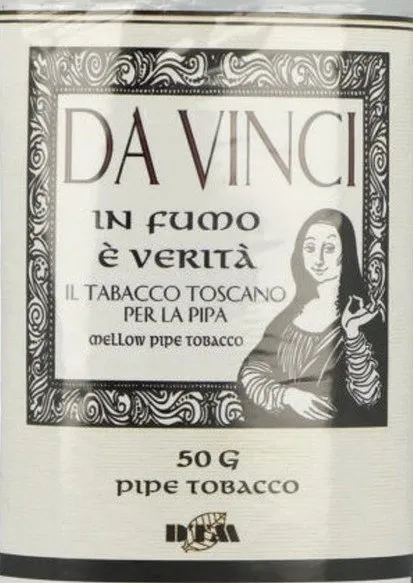
Da Vinci by Dan Tobacco – when Tuscan wine, wild honey, and vanilla meet in a pipe
While many aromatic pipe tobaccos rely on tried-and-tested flavors such as vanilla, cherries, rum, or chocolate, the German manufacturer Dan Tobacco took a slightly different path with its Da Vinci blend. Its inspiration came from Tuscany, Italy, its red wines, and wild honey. The result is an aromatic tobacco that seeks to combine Virginia’s natural sweetness with the fruity, slightly tart character of red wine. How successful was this unusual experiment?
From a German malt house to the Tuscan countryside
Although the tobacco’s name refers to one of the most famous figures of the Italian Renaissance, its home is not Italy but Lauenburg, Germany. This is where Dan Tobacco, also known by the abbreviation DTM – Dan Tobacco Manufacturing, is based, in an old brick malt house on a hillside above the Elbe River.
Its best-known blends include Blue Note, Devil’s Holiday, Sweet Vanilla Honeydew, and the Treasures of Ireland range.
Da Vinci is certainly no newcomer. TobaccoReviews mentions a tin from the mid-1990s, when the tobacco was also distributed under the CAO brand, although DTM was already listed as the manufacturer at the time.
One of the most interesting elements of its recipe is the use of red wine from the Chianti Colli Senesi region, a wine-growing area around Siena in Tuscany.
🍃 What’s in Da Vinci tobacco
The tobacco base is not particularly complex. The manufacturer primarily works with two components:
-
Bright Virginia – lends the blend natural sweetness, with delicate grassy, grain-like, and citrus notes.
-
Black Cavendish – brings softness, roundness, and a sweeter character to the smoke. It also provides a suitable base for flavoring.
The flavoring itself is considerably more intriguing:
-
Tuscan wild honey – contributes to the blend’s sweet character.
-
Red wine from the Colli Senesi region – adds fruity, vinous, and slightly tart notes.
-
Bourbon vanilla – rounds out the flavoring with a delicate, creamy touch.
Bourbon vanilla has nothing to do with American whiskey. Its name derives historically from the island of Réunion, formerly known as Île Bourbon.
According to the Dan Pipe catalog, the tobacco is matured with honey and red wine, then gently finished with vanilla.
The aroma upon opening: wine or fruit dessert?
With aromatic tobaccos, the aroma upon opening the package is often more pronounced than the flavor when smoked. Da Vinci is no exception.
Reviews describe sweet fruit, vanilla, caramel, and a wine-like aroma. Some smokers find notes reminiscent of dark fruit, while others mainly notice the sweetness of the Black Cavendish.
A wine-like aroma does not necessarily mean the finished tobacco will taste like a glass of Chianti. The original aromatic profile changes during tobacco processing and subsequent combustion. What may remain from the wine are mainly fruity, sweet-and-sour, and slightly spicy impressions.
🔥 How Da Vinci tastes when smoked
The main flavor component in Da Vinci is the sweeter Black Cavendish, followed by milder Virginia and fruity flavoring.
Alongside the sweetness, notes of hay, citrus, dark fruit, earth, and caramel also emerge. The wine component can come across as slightly tart, setting Da Vinci apart from aromatics based exclusively on vanilla or honey.
Can you really taste red wine in Da Vinci?
Some smokers can identify the distinctive wine flavoring, while others cannot. These differing experiences illustrate just how subjective the perception of aromatic tobaccos can be. What one smoker describes as red wine, another may perceive as fruity sweetness, caramel, or a combination of several indistinct flavors.
Burning characteristics and tobacco moisture
Da Vinci is a loose-cut blend that Dan Pipe describes as a combination loose cut. Reviewers’ experiences with its moisture and burning characteristics are not entirely consistent. Some report a fairly trouble-free burn, while others mention having to relight it repeatedly and finding residual moisture at the bottom of the bowl.
The differences may be due not only to the particular package and its age, but also to the pipe’s design, the tobacco’s moisture level, and the smoker’s individual technique.
👃 Room note and strength
The aroma of the smoke to those nearby is among Da Vinci’s most frequently praised qualities. Da Vinci is a fairly mild tobacco in strength.
Da Vinci is not the only tobacco with this name
There is one interesting detail to keep in mind when looking for information about this blend. There is also a tobacco called Da Vinci from the American manufacturer Cornell & Diehl. However, it is based on a combination of Virginia, Burley, and Latakia, making it a completely different type of tobacco.
While the German Da Vinci by Dan Tobacco is an aromatic blend with Tuscan wine, the American Da Vinci has a distinctly different tobacco base, with Latakia lending it a smoky character. The shared name is practically the only thing the two blends have in common.
Summary
Dan Tobacco Da Vinci is an interesting example of an aromatic pipe tobacco that seeks to move beyond the traditional world of vanilla, cherries, and rum.
The combination of Bright Virginia, Black Cavendish, Tuscan wild honey, red wine, and Bourbon vanilla makes for an unusual recipe with a distinctive place in the world of pipe tobacco.
Smokers’ experiences show, however, that the wine flavor itself may be far less clear-cut than the manufacturer’s description might lead us to expect. For some, Da Vinci is a fruity aromatic with a pleasant tartness; for others, it is primarily a sweet Cavendish with a hint of vanilla.