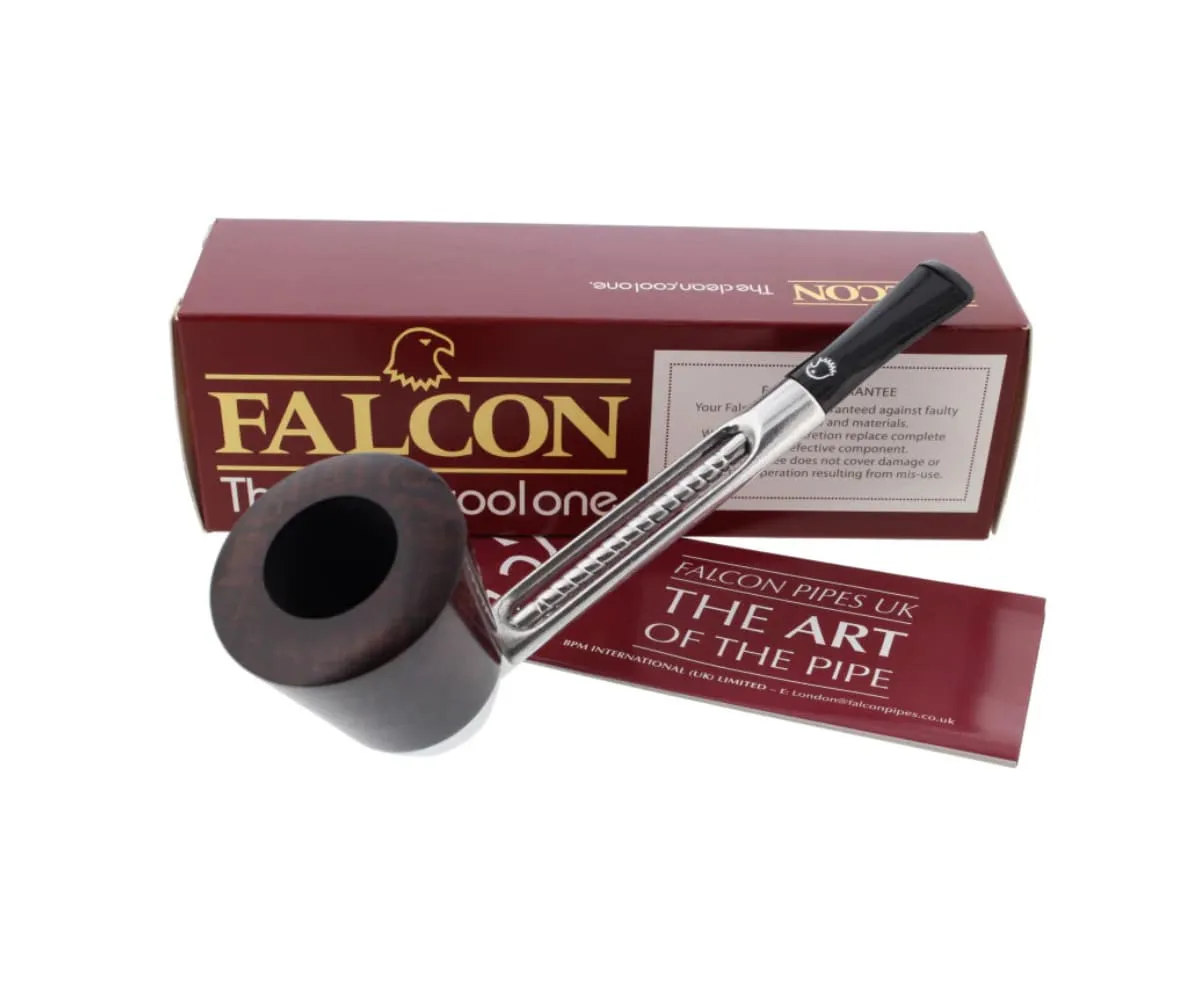
The Falcon Pipe: A Screw-On Bowl and a Dispute with Viking
Among the evidence in the 1955 New York dispute were seven Falcon stems fitted with bowls from the competing Viking. These assemblies showed that the parts fit together on the examples submitted. The court’s decision does not say who assembled them or whether anyone made a mistake in doing so. Other cases demonstrated brand confusion: customers and distributors sent Viking stems and bowls to Falcon’s exclusive distributor for repairs or replacement parts.
What Lies Beneath the Bowl
In March 1947, the American magazine Pipe Lovers described the Falcon Featherweight. At first glance, its screw-on briar bowl and exposed metal tube caught the eye. Smoke passed through the tube, while two supporting arms of the aluminum stem ran along either side. They connected the bowl chamber beneath the bowl to the mouthpiece.
A look beneath the unscrewed bowl, however, reveals more about how it works. In Kenly C. Bugg’s patent drawing a projection with a flat top rises from the center of the metal chamber. It extends into an opening in the bottom of the bowl, leaving a narrow gap around its perimeter for smoke to pass through. Condensation is intended to collect in the space around the projection. The tube’s inlet sits above the bottom of the chamber, which can be accessed for cleaning once the bowl is removed.
Viking Added Crossbars but Omitted the Corrugation
In 1954, advertisements for Falcon featuring a picture of the Viking appeared in two Detroit newspapers. The court also considered such cases of confusion as part of its examination of unfair competition. In its decision of February 4, 1955, it concluded that the manufacture and sale of the Viking constituted unfair competition. It then separately considered whether Viking had infringed the patent protecting Falcon’s design.
The Viking had two short crossbars between its side arms, clearly visible in the drawing in Jerome Gevirman’s patent. Its smoke tube also lacked Falcon’s spiral corrugation. The court found that neither difference altered the overall impression enough to prevent the Viking from infringing Falcon’s design patent D142280.
The outcome was the opposite for the patent on the construction itself, which was granted to Bugg in 1952. The court found it invalid because it saw no sufficient inventive contribution in the combination of known elements. The 1941 patent by Louis Silber, which the court also considered, already describes a removable screw-on bowl and a condensation chamber beneath it. In Silber’s design, however, the chamber was concealed inside a body that could be made of Bakelite. On the Falcon, the arrangement of the metal parts was exposed—and it was their resulting appearance that prevailed in the dispute.
What a Pipe Without Its Bowl Can Reveal
The Viking involved in the court case did not look like all later pipes bearing the same name. An example at the Amsterdam Pipe Museum, dated to 1960–1970, has a flattened metal stem with cooling fins on top. When examining an old example, it is therefore worth checking the underside for markings as well as looking closely at the stem’s construction. A bowl may be from the same period and fit well, yet still not belong to the frame with which the pipe was originally sold.
Another example of how a practical feature changed a pipe’s silhouette is the Dunhill Patent Shield Pipe with a wind shield.
Sources
- Falcon Industries, Inc. v. R. S. Herbert Co., 128 F. Supp. 204 — decision of February 4, 1955
- Pipe Lovers, March 1947, p. 88 — New Featherweight Pipe Is Announced by Falcon
- Kenly C. Bugg: Tobacco Pipe — U.S. patent US2581169
- Jerome Gevirman: Smoker’s Pipe — U.S. design patent D171694, March 16, 1954
- Louis Silber: No-shank Pipe — U.S. patent US2236076
- Amsterdam Pipe Museum — Dr. Grabow Viking, collection item APM 3.289
- Etrafika.cz — About Falcon pipes (the article does not repeat the claim that they date to 1936)